
The Journey and The Question: Rosh Hashanah 2026
“I was born in hiding, and I refuse to die in hiding.”
On October 7, 2023 Bret Stephens’ mother witnessed on TV Harvard students accosting a fellow student on campus because the victim happened to be Jewish. Despite this, she and her son refuse to label the protesters as Pro-Palestinian, as they are the opposite. They are Pro-Hamas. Anyone celebrating the three weeks following October 7, the attack on innocents, the murder, bloodthirsty in-person rape, and killing that occurred, is Pro-Hamas. Israel had not yet responded, but they were ready to pounce. Who had primed them? Ever wondered how that phenomenon happened? I was in New York City on that day and saw the sudden explosion of Palestinian flags and kaffiyas on the streets.
If you were protesting and cheering, you were and are pro-Hamas and pro-terrorist, completely the opposite of pro-Palestinian. Hamas is NOT pro=Palestinian. They don’t care about Palestinians. They built tunnels the like of which was never seen in history, for years using money that was meant to make Palestinian lives better on this system of tunnels, not on the Palestinian people. I defy you to show me any proof of a normal non-Hamas Palestinian who was allowed into the tunnels to protect themselves. Hamas hid under these people, beneath them literally.
Now, think for a minute what the world would have said if the IDF, the Israeli army, had chosen to hide behind its citizens of women, children, elderly, and babies. The world would have been disgusted, you know, and Hamas? They would have cheered and then wiped out as many as they could. They willingly planned for a massive destruction of Gaza, counting on Israel to deliver to the world spectacles of death and destruction as part of their battle plan. As Einat Wolf puts it, we know the goal has never been to establish a Palestinian state side by side with Israel. How do we know? Back in 1947 Ernst Bevins, the UK foreign minister, no friend of the Jews, was sent to the middle east to study how they might solve the partition-he returned with a report which he said proved the two sides had irreconcilable differences: “For the Jews, the essential point is the creation of a sovereign Jewish State. For the Arabs, the essential point is to resist to the last the establishment of Jewish sovereignty in any part of the land.” Palestinian leaders walked away from peace offers with Prime Minister Ehud Barak in July 2000 (at the Camp David Summit) and January 2001 (at Taba), and Mahmoud Abbas walked away from everything offered by Prime Minister Ehud Olmert in September/November of 2008 which included 96% of the west Banlk, Gaza and East Jerusalem.
Yes-Israel made the tragic and arguably impossible decision to retaliate by mirroring their opponent’s actions. Leaving Hamas unanswered would have been akin to crowning the head of evil. Now, three years later, we are left with the aftermath, simultaneously honoring and memorializing the 25th anniversary of September 11. On that day, other Muslims trained and orchestrated a complete eclipse of humanity by piloting planes into buildings and striking America in the heart. America has a short memory. The 25th anniversary of September 11, 2001, marks the 25th anniversary of nearly 3,000 human beings who went to work, boarded airplanes, entered the Pentagon, and began an ordinary Tuesday morning—only to never return home. We remember the horror of that day. However, we should also remember the events that followed: firefighters rushing toward collapsing buildings, strangers carrying strangers, Americans lining up to donate blood, communities gathering in churches, synagogues, and mosques, and allies around the world standing with America, pledging that terrorism, hatred, and evil would not have the final say.
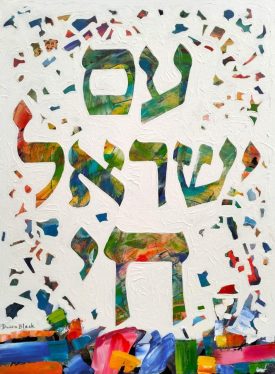
There is a phrase we Jews use so often that I wonder if sometimes we stop thinking about what it actually means: Am Yisrael Chai. The people of Israel lives. This doesn’t refer to the state but to all Jews.
We sing it. We shout it. Especially since October 7, we have seen it on banners and T-shirts, heard it at rallies and concerts and funerals. And usually we understand it to mean: We’re still here. They tried to destroy us, and we’re still here. Pharaoh couldn’t do it. The Babylonians couldn’t do it. The Romans couldn’t do it. The Crusaders and the Inquisition and the pogroms couldn’t do it. Hitler couldn’t do it. Hamas couldn’t either.
And that is certainly true. But as we enter these High Holy Days, I find myself wondering whether that understanding is actually too small. Because survival alone is not the miracle of Jewish history.
Continuity is.
Survival means somebody failed to kill you. Continuity means that afterward, somehow, you got up and began building again. You had another child. You opened another school. You wrote another book. You planted another tree. You composed another melody. You argued over another page of Talmud. You started another business. You told another joke. You fell in love again. You lit candles on Friday night—and then you taught your children to light them.
That is Am Yisrael Chai. Not simply that the Jewish people survived, but that again and again, the Jewish people chose life. 
For all that has happened in the quarter-century since, there was something extraordinary in that determination. Evil had destroyed, and human beings responded by affirming life and one another.
How do we choose to live? In a world dipped in negativity and fear, one in which many of us dwell in nonstop hate-filled TikTok clips feeding a frenzy within us?
I don’t know about all of you but I imagine many are like me: I haven’t felt safe for some time. I haven’t felt as if I’m standing on terra firma, in the world of my childhood and upbringing in which being Jewish, going to shul, being the kid who could walk down church street the main commercial thoroughfare in Burlington Vermont and hearing -hey you’re Frankie Goldstein’s kid, right?
Now, l’ hevdel as we say in Hebrew-the complete opposite. We hide our mezuzahs and our stars of David and lower our voices and many try not to be seen, identified, and who can blame you when the anti-forces are harassing and threatening and bullying their way to power with hate in their eyes and hearts.
But I want all of you here and those listening on livestream to consider very carefully what it might mean to grow up or be young in such a world as this if you’re Jewish? And what you and I are doing about it?
Because once again we live in a time when hatred is loud. Antisemitism is no longer hiding at the edges. And many of us understandably ask: What can we possibly do about all of this?
But—-I think these High Holy Days of 5787 ask us to begin with a different question. What in G-d’s name, in our ancestors’ name, in the name of our parents and children and loved ones are we going to build in response?
How will we contribute to Jewish continuity, Jewish celebration and Jewish affirmation?
IN other words-How in all that is worthy of our inheritance will we show the next generation more hope, not less; more possibility, not a surplus of despair; more Yiddishkeit; more community; more learning; more laughter; more reasons to experience being Jewish not merely as something we must defend, but as something we are incredibly fortunate to possess?
Because Judaism cannot be transmitted simply as a warning. Be Jewish because people hate Jews is not enough.
Who would want to inherit that?
Yes. We must teach Auschwitz. We must remember October 7. We must confront antisemitism and defend Israel’s right to exist. But those cannot constitute the entirety of the inheritance we hand our children and grandchildren.
We have to give them something worth inheriting.
And whenever I think about this, I think about a man I had the privilege of knowing–Kurt Bronner.
Kurt survived the Holocaust. He watched his father die. The last time he saw his mother, she was on the other side of barbed wire at Bergen-Belsen.
Think about what that means. Think about what images a human being carries inside after experiencing something like that.
Kurt survived, eventually came to America, and built a life with his wife, Rosalie. They created a family. He spent years telling his story to schoolchildren so that what happened would not disappear when the eyewitnesses were gone.
But there is something else about Kurt that has remained with me.
Kurt loved photographing flowers.
Flowers. Nature. Beauty.
And I remember being struck by the almost impossible contradiction of it. How does a man whose eyes had witnessed what Kurt’s eyes witnessed still possess the capacity to see beauty?
How does someone who watched his father die, who last saw his mother through barbed wire at Bergen-Belsen, pick up a camera years later, focus its lens on a flower and say, in effect: Look at that. Look how beautiful.
I have come to believe that this was one of the most mystical, magical—and completely Jewish—things I have ever encountered.
Because Hitler’s answer to the Jewish future was: There will be no Jewish future.
And Kurt’s answer was his life. His marriage to Rosalie was an answer. Their family was an answer. Every classroom of young people who heard his testimony was an answer. Every photograph of a flower was an answer.
You showed me ugliness. I will still see beauty.
You showed me death. I will create life.
You tried to erase the story. I will tell it.
That is Am Yisrael Chai.
And perhaps it is also the deepest meaning of what we are doing here on the High Holy Days.
Because teshuvah itself is an act of Jewish continuity.
Think about that.
We don’t enter a new year because the old year was perfect. We don’t stand before God because everything turned out fine. We don’t ask forgiveness because we never failed.
Quite the opposite.
We come here carrying our failures. Our disappointments. The relationships we neglected. The words we wish we hadn’t spoken. The words we wish we had. The people we hurt. The opportunities we missed. The promises to ourselves we somehow didn’t keep.
And Judaism says: Come back anyway. Return. Teshuvah.Try again. The next page has not yet been written.
That is an astonishingly life-affirming idea.
Continuity doesn’t mean everything turns out fine. Continuity means we build while everything is emphatically not fine.
That has been the Jewish story from the beginning. Come Journey with me through the past.
The Romans destroyed Jerusalem and the Temple, the very center of Jewish religious existence. If you were writing the history of civilizations then, you might reasonably have written: End of story.
Instead, our ancestors reinvented Jewish life.
No Temple? The home could become a sanctuary. No sacrifices? Prayer could take their place. No priesthood at the center of Jewish life? Teachers and scholars could become our leaders. Jerusalem inaccessible? Then we would face Jerusalem when we prayed.
And at every Passover table we would say: L’shanah haba’ah b’Yerushalayim. Next year in Jerusalem.
Imagine the audacity of that sentence.
And the audacity of working with our fellow citizens to battle injustice. Rabbi Abraham Joshua Heschel for whom Yaffa and Batsheva and Elisha’s school from K-9 was named here in LA, wrote about his work with the civil rights movement, “Legs are not lips and walking is not kneeling. And yet our legs uttered songs. Even without words, our march was worship.” He viewed the civil rights marches not merely as political acts, but as a deeply spiritual religious obligation that Judaism requires, an active intervention against injustice, echoing the calls of ancient Hebrew prophets. He said of marching with King in Selma: “I felt as if my legs were praying.”
Our hearts and legs and minds and creativity and active pursuit of knowing our story is part of the statement: L”shana ha’ba’ah b’Yerusahalaym For nearly two thousand years Jews said it in Baghdad and Warsaw, Casablanca and Yemen, Spain and Germany, Russia and Poland and America. Sometimes Jerusalem was thousands of miles away. Sometimes getting there was virtually impossible.
Still: Next year in Jerusalem.
Generation after generation.
And that is what the Nazis misunderstood about us. Their ambition was not merely murder. It was erasure. No Torah. No Hebrew. No Jewish music. No Jewish children. No Jewish future.
And yet the ultimate answer to Hitler is not merely that some Jews survived.
It is the grandchildren. It is you and those allies who stand together sitting here or tuning in today.
It is the great-grandchild asking for another piece of challah. It is somebody complaining that the soup needs salt. It is a teenager rolling her eyes because Grandpa is telling the same story again. It is a child learning the aleph-bet. It is Hebrew—a language of prophets—becoming the language of preschool and traffic jams and grocery lists and people arguing over parking spaces in Jerusalem and Tel Aviv and Haifa..
The victory is ordinary Jewish life. And the instinct was: Build.
When threatened, build. When grieving, build. When frightened, build. When uncertain, build. There is something profoundly Jewish about answering destruction with creation.
And now that inheritance has reached us.
Think about it. Somebody before each of us had to choose this, again and again.
Someone had to light the candles. Someone had to remember the melody. Someone had to tell the Exodus story. Someone had to carry the Torah. Someone had to teach a child the aleph-bet. Someone had to whisper the Shema. Someone had to pack a siddur into a suitcase. Someone had to leave Spain or Russia or Poland or Iraq or Iran or Yemen or Morocco. Someone had to cross an ocean. Someone had to start over.
And because they did, we are here.
But continuity is not automatic.
Our ancestors handed something to us. Now it is in our hands.
So perhaps these High Holy Days ask us some hard questions.
What will we do with it?
Will we know enough Judaism to tell its story? Will we create Jewish homes filled not merely with anxiety about antisemitism, but with joy? Will our children associate Judaism only with Auschwitz and October 7—or also with Shabbat dinner, music, community, learning, justice, laughter, Israel, love?
Will they know the sheer joy and inspiration that can come from being a Jew?
Will they understand that Yiddishkeit isn’t simply something from the past? It is something alive, something that belongs to them, something they can question and wrestle with and shape and ultimately hand forward.
Perhaps that is what **L’dor Vador—from generation to generation—**really means.
It isn’t merely a description. It is an assignment.
Kurt Bronner did that. He carried memories no human being should have had to carry. But he also carried a camera.
And somehow, after Bergen-Belsen, Kurt could still look through that camera and see a flower.
Maybe that is the image I want us to carry into this new year. Because the world will give us plenty of reasons to look at the barbed wire.
Judaism asks us not to look away from it. But Judaism also insists that we keep looking for the flower.
To confront evil—and still choose goodness.
To remember death—and still celebrate life.
To know our history—and still imagine a future.
To acknowledge where we have failed—and still believe we can change.
That is continuity. That is strength.
That is Jewish vibrancy. And that is Am Yisrael Chai.
We chose to live.
On this New Year, may we not merely ask whether the Jewish people will survive.
May we ask what each of us can do to make Jewish life more connected, more courageous and more alive. What can we do to join hands with fellow human beings who are willing to call out anti-Jew hatred and racism of all kinds.
May we give the next generation not less hope, but more.
Not merely warnings about those who hate us, but reasons to love who we are.
Not simply the burden of Jewish history, but the extraordinary privilege of carrying it forward.
May we have the courage to confront the barbed wire.
And may we never lose the capacity to photograph the flowers.
L’dor vador. Amen V’Amen.
JG
